
It’s that time in December when we inevitably end up asking the question: what, exactly, captured people’s attention over the past year? The list below is one answer. Thank you, as ever, to our contributors for the work (and the obsessions), and to our Friends for quietly underwriting the whole endeavour. From the 60 collection posts, 20 essays, and 1 conjecture piece that we had the honour to publish this year, here's a rundown of the ten most read.
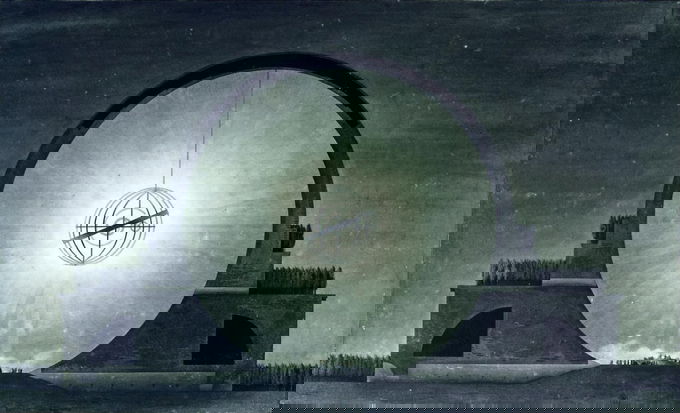
As dissatisfaction with the old regime fermented into revolutionary upheaval in late-eighteenth century France, two architects cast off the decorative excesses of the Baroque and Rococo styles and sought out bold, new geometries. Hugh Aldersey-Williams tours the sublime and mostly unrealized designs of Étienne-Louis Boullée and Claude-Nicolas Ledoux, discovering utopian ideals crafted in cubes, spheres, and pyramids. Read More »
***

The earliest known depiction of a crop circle illustrates The Mowing-Devil (1678), a 5-page pamphlet which recounts a labor dispute ending with an unwitting deal with the devil, and a field mown in way “that no Mortal Man was able to do the like”. Read More »
***

A gathering, in high resolution, of a selection of 74 key works by the era-defining English illustrator Aubrey Beardsley (1872–98). Read More »
***
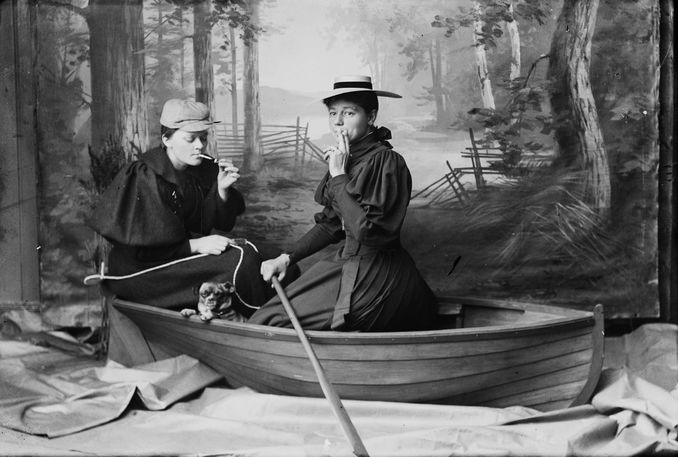
In the 1980s, a suitcase marked “private” was found in a barn near Oslo. Inside? Hundreds of playful, radical photos by the couple Marie Høeg and Bolette Berg — subversive visions of gender and sexuality in early 1900s Norway. Read More »
***

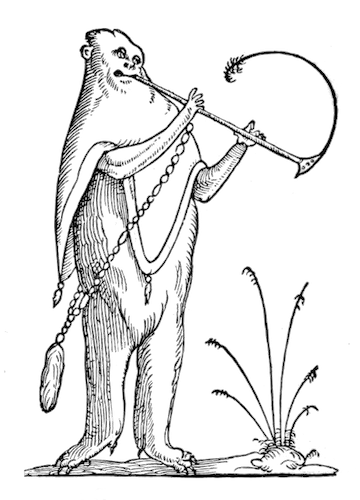
Meet the Blemmyes, mythical headless humanoids whose eyes, nose, and mouth are embedded in their breast — explore illustrations of this chest-faced wonder across more than half a millennium. Read More »
***

Centuries before photography froze the world into neat frames, scientists, poets, and artists streamed transient images into dark interior spaces with the help of a camera obscura. Julie Park explores the early modern fascination with this quasi-spiritual technology and the magic, melancholy, and dream-like experiences it produced. Read More »
***

In 1899, Charles Godfrey Leland published Aradia, “the gospel of the witches”, containing a goddess-orientated creation and saviour narrative, purported to descend from an ancient, hermetic tradition of witchcraft in Italy. A. D. Manns explores this text via an enchanting conjecture: that the writer, medium, and witch Roma Lister played a pivotal role in the formation of both Aradia and, therefore, a new form of paganism called Wicca. Read More »
***

In 1853, John Benjamin Dancer achieved a feat of seemingly impossible scale: he shrunk an image to the size of a sharpened pencil tip. Anika Burgess explores the invention of microphotography and its influence on erotic paraphernalia and military communications. Read More »
***

After Alma Mahler married another man, the Austrian artist Oskar Kokoschka hired a puppet maker to recreate her as a life-size doll, complete with “fine, curly horsehair” on her “parties honteuses”. What he got, instead, was a monster made of swan skin. Read More »
***
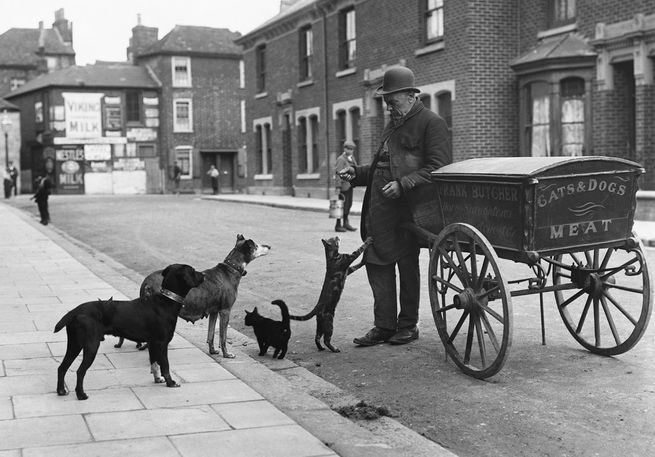
As cats evolved from feral ratters into beloved Victorian companions, a nascent pet-food economy arose on the carts of so-called “cat’s meat men”. Kathryn Hughes explores the life and times of these itinerant offal vendors, their intersection with a victim of Jack the Ripper, and a feast held in the meat men’s honor, chaired by none other than Louis Wain. Read More »