

Julien Offray de La Mettrie’s Man a Machine (1749 edition)
In 1637, the French philosopher René Descartes caused a stir by claiming, in his Discourse on the Method, that animals are little more than machines. When, a bit over a century later, in 1747, the French physician Julien Offray de La Mettrie (1709–51) extended the argument to humans, he was driven into exile.
Frederick the Great, whose court had for decades been the refuge of controversial Frenchmen like Voltaire, was pithy about the scandal in his 1751 funeral oration for La Mettrie, who served as Frederick’s court physician:
This work, which was bound to displease men who by their position are declared enemies of the progress of human reason, roused all the priests of Leyden against its author. Calvinists, Catholics and Lutherans forgot for the time that consubstantiation, free will, mass for the dead, and the infallibility of the pope divided them: they all united again to persecute a philosopher who had the additional misfortune of being French.
La Mettrie’s argument was as simple as it was radical: if, as Descartes argued, animals are a kind of machine, why wouldn’t man be? Are we not also ultimately ruled by the physiological effects of blood and humors? La Mettrie’s experience as a physician, including in the War of the Austrian Succession, had taught him that the human body, and thus man himself, had its limits. Both physical and mental balance were dependent on the health of the body, and the will or soul could only do so much. “We think not, nay, we are not honest men, but as we are cheerful, or brave; all depends on the manner of winding up our machine.”
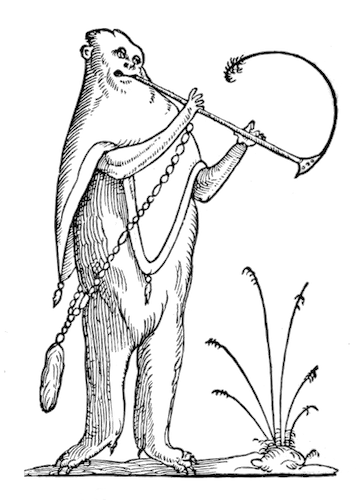
For Descartes, the thing that distinguished man from beast was the ability to speak, which indicated the presence of a soul. Sure, La Mettrie answered — but that was maybe a mechanical issue of the simian mouth and tongue, not a question of fundamental difference. Especially with the recent development of sign language, “the similitude of the structure and operations in the monkey are such, that I scarce doubt, but that if we carefully tutored this animal, we might teach him to speak, and by consequence to understand, according to his capacity, a language. Then he would no longer be a wild or imperfect man; he would be a compleat man, a little polite fellow”.

Georg Friedrich Schmidt, Portrait of Julien Offray de La Mettrie, 1770 — Source.
To call man an animal (and therefore a machine) was bad enough, but the real problem was that La Mettrie was attempting to disprove the existence of God. In Man a Machine, reportedly written relatively quickly, he accused Descartes and other deists of being cowards and bigots, able to see for themselves the proofs given by nature but unwilling to accept them. Even in Leiden, a haven for eighteenth-century radicals, that was going a bit far. (It also didn’t help that he had a habit of picking fights in print, and indeed Man a Machine directs its ire against nearly every prominent philosopher, including Locke, Leibniz, and Malebranche. Francis Bacon, however, is “my lord”.)
The text presented here is the first edition of the English translation of the work, which appeared soon after the French. Likely on the basis of a note in the back of the anonymous French edition, the English translation attributes the text to the French nobleman Jean-Baptiste de Boyer, the Marquis d’Argens (1704–71), a fellow exile at Frederick’s court who was known all over Europe for his best-selling pornographic-cum-philosophical novel Thérèse philosophe (1748).
A breathless preface (signed only as MAN) makes clear the discursive stakes of the work, and the enemies against whom it is directed: “a particular set of men, who seem to have an interest in opposing whatever encourages us to shake off the manacles with which custom, prejudice, and education, have fettered human reason.” Perhaps unsurprisingly, then, according to Lieve Jooken and Guy Rooryck, the anonymous translator made the English edition even more polemical, perhaps because English readers flattered themselves on being infinitely more liberal and free-thinking than their French counterparts.
And La Mettrie’s text is, in many ways, shockingly modern. He was a neo-Aristotelian materialist who anticipated modern ape speech experiments; he argued that certain criminals, especially postpartum women, should be able to be found not guilty by reason of insanity. He even, like Lacan, suggested that the imaginary was primary, that all communication was symbolic. Sometimes he sounds like Bruno Latour. Yet at other moments, he is a man very much of his time: he writes of the humors and physiognomy and how, in the realm of reproduction, “the man does all, whilst the woman as it were enjoys a profound sleep, and is lost in a sort of extasy”. Well, it was still the 1740s.
Reportedly a charming, ebullient man, La Mettrie eventually lost friends in Potsdam — including Voltaire and d’Argens — through too much bon vivanterie. His publication of L’Art de jouir (1751), a defense of hedonism, was the last straw. He wanted desperately to go back to France, but died unexpectedly at a party, supposedly after eating too much truffle pâté. He was subject to a damnatio memoriae until well into the nineteenth century; today he is considered the forefather of cognitive science.
“This is my system”, he wrote at the end of Man a Machine. “Or rather, this is the truth, if I am not much mistaken. It is short and plain: Let who will dispute it.”
Enjoyed this piece? We need your help to keep publishing.
The PDR is a non-profit project kept alive by reader donations – no ads, no paywalls, just the generosity of our community. It’s a really exciting model, but we need your help to keep it thriving. Visit our support page to become a Friend and receive our themed postcard packs. Or give a one-off donation. Already a supporter? A huge thank you for making all this possible.


 | Underlying Work Rights | PD Worldwide |
| Digital Copy Rights |
| |
 | Download | PDF, eBook and other formats |
Nov 24, 2026